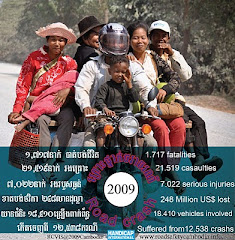
Friday, February 13, 2009

School Chidren wearing helmet during bycling

By Kimvong
Friday, 13nd Feb 2009


After the regulation of wearing helmet for motor driver, trycle motor driver was enforced in the provinces and city, the helmet wearing rate properly increase in the hold country. After the mass media have aware of useful of helmet again and again the knowledge of motorist have change, they understand about their self esteem and cost of road traffic accident. Whilst the traffic police enforce on wearing helmet not only motorist use helmet but the school student they are also aware of road safety so that they decided to wear helmet although they are only cycling.

Based on statistic from Handicap International Belgium showed that before 2004 the number of children wearing helmet is ZERO but after 2004 this statistics increase up to 4% wearing helmet, up to now the number of children wearing helmet rapidly increase but there aren't any calculate about this statistics.

Children who are the passenger should wear helmet to protect the head in case of road traffic accident.
helmet for bicycle are also available now

Tuesday, February 10, 2009

Two Brothers Killed in Shock Land Traffic

More and more Cambodian die on the road

Kampongcham Province: Two brothers: Phen Thea, 30, and Phen Phat, 28, were killed in a traffic accident in Kampongcham province. The fatal traffic accident occurred on Sunday at 8:30 A.M in Angdoung Chros village, Kampongsiep district’s Ompel commune on the national rout number six. The wounded driver, who lives in Kratie province, escaped after causing the accident. The eyewitnesses said that at the spot, the speeding car overtook a gasoline containing truck. Then ran into the two men, who were driving their Viva motorbike in the different direction to their company in Kampongthom province. Kampongsiem district traffic police Ngen Hen said that the car and a driver assistant were taken into police custody.

Source

Thursday, February 5, 2009

31 persons killed in road traffic accident just only 6 days during Chinese New Year

Written by Kimvong
05 Feb 2009

Road traffic accident during Chinese New year decrease in 2009

According to report from department of order, Ministry of interior showed that the number of traffic accident during Chinese New Year in 2009 decreased if compare to year 2008.

Number of fatality decrease from 46 persons in 2008 to 31 persons in 2009.
Generally, number of road traffic accident (RTA) rapidly increase during National Holiday or any celebrations if compare to normal day.

Why number of RTA increase in National Holiday?
This question is easy to understand if we take a few minute on the road and pay attention to the traffic flow on the road. During National holiday number of vehicles on the road are much more than normal day, number of long distant travelers more and on these day number of people drinking alcohol and driving are more than proper day.
One other reason of RTA is drive over speeding or driving with in appropriate speed.
Phnom Penh is the highest place than Battambong and kampong Cham province are higher record of road traffic accident during Chinese New year 2009

Based on National new also mention about road traffic accident as
Phnom Penh Post

Friday, January 30, 2009

Road Traffic Accident Increase on Chinese New Year 2009

Based on first statistic from Phnom Penh traffic police said that during Chinese new Year 2009 the road traffic accident increased 16 cases that cause to have 6 fatalities, 16 persons get serious injury , and other 12 persons get slight injury, this just in Phnom Penh and from 25 to 29 January 2009.

Most of traffic accident occurred in Khan Chamkamon, Daun Penh, Russey Keo, and Daun Penh. Cause of traffic accident were: drive over speeding, drunk driving, Overtaking, Driving opposite traffic flow, and not respect the traffic sign.
From Koh Santepheap Daily
Friday, 30th Jan 2009.

Thursday, January 29, 2009

First statistics of road traffic accident during Chinese New Year

Written by kimvong
Thursday, 29 January 2009

Road traffic accident is a main public health issue for Cambodia which was a third world country in region countries. In Cambodia, the number of road traffic accident are rapidly increase during holidays or any others celebration.

Generally, Chinese New Year is celebrated on January or February every year it is a custom of Chinese who living in Cambodia or as others countries. on 25th to 28th this month in Phnom Penh the volume of traffic seem calm down while the number of vehicles are moving from Phnom Penh to provinces or most people are being prepare to offer food to the spirits.

On the first day in Phnom Penh, 25 January unofficial statistics of road traffic accident showed that there were five people died, six get seriously injured and seven get slight injuries. the number of road traffic accident this year may increase if compare to the year 2008.

related info
Road deaths rise on holiday

Chinese New Year and Road Safety - 5 Safety Tips

Friday, January 23, 2009

New helmet law hamstrung by lack of quality guidelines: NGOs

The lack of standards relating to the quality of motorbike helmets is endangering road users


DESPITE the much-touted introduction of the new helmet law - which makes protective headgear compulsory for motorbike drivers - over two weeks ago, drivers and passengers are still at risk due to a lack of regulations governing the quality of helmets sold in the Kingdom.

Safety officials have warned it could take up to a year before there is an approved safety standard for motorbike helmets, adding also that it will be several months before the helmet law applies to passengers.

The new law came into force on January 1, in a bid to reduce fatalities and serious head injuries on the roads.

Under the new law, motorbike drivers - but not passengers - must wear a helmet, or face a fine of 3,000 riels ($0.73).

But despite the government claiming to have achieved a 92 percent compliance rate in Phnom Penh, the National Culture and Social Morality Centre (NCSMC), a local NGO, warned that more than 30 percent of helmet- wearers are still putting themselves and other road users in danger by not wearing quality helmets.

Po Samnang, director of the centre, argued that there needs to be a public information campaign to raise awareness of the importance of high-quality helmets.

"Our people will suffer serious injuries in traffic accidents, as some helmets worn cannot protect their heads," he said. In some cases, motorbike riders have been seen wearing plastic construction hard hats or other inappropriate headgear as substitutes for a proper motorbike helmet, he added.

Cheap, poor-quality helmets are being sold on the streets of Phnom Penh for as little as $3.50.

Ach Heng has been selling helmets, which she sources from Thailand and Taiwan, on the streets of the capital since 1997. While she insists that her helmets are of the highest quality, she says there are no official guidelines, checks or controls on the quality of helmets on sale.

She said often the price of helmets can indicate their quality. "My helmets cost between $8 and $150, but those costing $3 or $4 are not good quality," she said.

Socheata SANN, road safety program manager at Handicap International Belgium, said it will likely take up to a year for the National Committee for Road Traffic Safety to approve a basic helmet standard for Cambodia.

"In November 2008, the government sent 10 different helmets to the United States to be tested. Of the ten helmets sent, only four were approved as being of a suitable quality," he said.

Concerns over the Kingdom's dearth of quality helmets have prompted various institutions to launch nationwide helmet campaigns that will run over the course of the coming year.

The NCSMC will hold a campaign about the new traffic law and the importance of wearing quality helmets in Phnom Penh this Sunday.

In three months time, Handicap International will launch a national television campaign accompanied by thousands of leaflets to be distributed around Phnom Penh, informing consumers of what to look for in a good helmet.

El Narin, deputy director of Phnom Penh's traffic police, said it is difficult for law enforcement officers to take action on drivers wearing poor-quality or inappropriate helmets.

"Police don't have a plan to deal with drivers who wear unsuitable helmets. We are trying to introduce helmets step by step but haven't yet defined the quality of the helmet they have to wear," he said.

So while there may now be a swarm of helmets on the roads, whether there will be a decrease in head injuries from traffic accidents remains to be seen.

Photo by: Tracey Shelton
Moto-taxi driver Bun Ly tries on a new helmet from a street-side stall in Phnom Penh last week.

Written by MOM KUNTHEAR and SARAH WHYTE
Thursday, 22 January 2009

Wednesday, January 21, 2009

Riverfront pavement cleared

Municipal officials remove furniture, clothing racks in attempt to beautify capital.
EARLY Sunday morning, as tourists dined at the Tonle Sap riverfront cafes and street-sellers pedalled their goods, a team of police began clearing the footpath of all chairs, tables, dining tourists, signs, motorbikes and ornaments.
The move came three days after a warning notice was issued telling businesses to clear the street area in front of their properties.
A police officer who did not wish to be named said the area was being cleared because it was a place tourists liked to walk.
"We have told [business owners] several times via letter and loudspeaker, but they have never listened, so we are now acting on our warnings," he said.
The reaction from business owners and tourists was mixed, with some welcoming the clearing of the sidewalks and others grumbling over the loss of shopfront seating areas.
"It's more beautiful for the tourists but not so good for my shop," said Siv Kheng, who runs a clothing store on the corner of Street 130.
"I'm not sure there is even room for my staff to fit inside now," she said.
For Australian tourist Matthew Bolton, who witnessed the upheaval from the (former) outdoor seating of Garden Bar in the Shade, the move was not necessarily a good thing.
"We came to Cambodia with an idea of embracing Khmer culture and to us the bustling, active streets are part of its character," he said.
But Bolton's 10-year-old son Bleys disagreed, saying the new look not only provides more space to walk but there are "less people to hassle you".
Phsar Kandal commune Chief Kong Rith said no fines had yet been issued for noncompliance, but he warned that failure to obey the directive would result in items being confiscated.

Sunday, January 18, 2009

GMS: Cambodia Northwest Provincial Road Improvement Project

Asian Development Fund US$33.00 million
Thematic Classification: Sustainable Economic Growth

Project Rationale:
Due to low access to markets and other social services, including along key natural and cultural tourism sites, there is an urgent need to improve connectivity within northwestern Cambodia. Through rehabilitation of the unpaved road sections of National Road (NR) 56 and upgrading of the cross border facilities with Thailand at O'Smach, the project will improve connectivity in northwestern Cambodia as well as its links with national road network as well as with regional transport corridors, thus increasing its producers and traders access to markets and its populations access to social services. It will also effectively support regional trade and cooperation between Thailand and Cambodia. Further, the project will assist the Government in its ongoing routine road maintenance and road safety programs.
The projects main benefits, therefore, are: (i) improved access to agricultural and tourist areas in the northwestern parts of Cambodia, with reduced travel time and transport costs, and (ii) improved regional cooperation between Cambodia and Thailand. Such regional cooperation will be actualized through: (i) improved cross-border facility at OSmach; (ii) more sustained routine road maintenance program of MPWT that will reduce road user costs and road agency costs; and (iii) improved road safety in Cambodia, thus, reducing losses due to traffic accidents.

Impact:
The impact of the project will be to initiate rehabilitation of the network of secondary national roads to reestablish dependable and economically efficient links between the rural roads networks and the primary national roads network.

Outcome:
The Project outcome will (i) provide reliable all-year road access from provincial towns and rural areas to markets, employment, and social services such as advanced health and education facilities; (ii) provide access to historical and natural sites that can form the basis for development of the tourism industry; and (iii) increase the efficiency of the transport sector by enabling more direct routes to international border crossings that facilitate bilateral trade. The roads will promote economic development in rural areas and provincial centers and facilitate social development by reducing remoteness. The project will achieve this by improving selected secondary national highways, specifically: (i) rehabilitating NR56 from Sisophon to Samraong (114 km); and (ii) upgrading the border post on the Cambodia-Thailand border at Osmach.

Outputs:
Rehabilitated road links that provide access to agricultural and tourist areas in the northwestern region of Cambodia, and an important secondary border crossings between Cambodia and Thailand that supports improved regional cooperation. Improved ongoing routine road maintenance program of MPWT. Continued improvements in implementing the road safety action plan.


For more information


Regarding to this information i am very delight to hear and Cambodia will be expend the road that can help in transportation system that easy for traveling prom provinces to provinces and in the text it will connect to Thai ( Siem) country that is a neighbor country.

For this a part of my delight i also feel sad if the ministry of Public Work and Transport do not regard the traffic flow, traffic sign and some accessories but it very important to road user like sidewalk especially for disable person.

Another one without road safety education the number of road traffic accident will dramatically increase a long this new road (NR 56)

Monday, January 12, 2009

Road Safety is No Accident


Slow down, you are not a gentle if you drive over speeding or inappropriate speed,

In Cambodia speeding is a main cause of traffic accident.

How to buy a quality helmet that can protect your life

How To Buy the Right Helmet

You drive a motorcycle because you appreciate the thrill of connecting intimately with your driving experience. Still, you need to balance the adventure with good safety habits. Whether you are buying a new helmet or evaluating your existing head protection, there is a lot to consider when deciding which helmet is right for you.
Helmet Safety Ratings
Common sense and statistics argue for the benefits of wearing a helmet. To make sure your helmet does what you need it to, the U.S. Department of Transportation (DOT) has issued a standard that certifies helmet models that pass rigorous laboratory testing.
When you shop for a helmet, the first thing you'll want to see is the DOT sticker proving the helmet design meets the DOT safety standards and provides these three primary functions:
• Impact protection
• Penetration protection
• Retention
Your helmet protects you from impact by distributing the force across the outer shell and the impact-absorbing liner―expanded polystyrene, or EPS. You should know that once you have suffered an impact, the shell and EPS systems are compromised and you'll need to replace the helmet. Take comfort in knowing your helmet did its job.
Penetration protection comes from the outer shell, which is designed and tested against typical road hazards like flying objects. Some shells are also scratch resistant, which means they won't be marked by rogue bugs, rocks, or sticks.
Finally, the retention system must keep the helmet on your head during an impact. The DOT-certified models are tested for retention. How well your helmet fastens and stays on your head will depend on not only the retention system, but also the fit.
Fit and Comfort
Fit and comfort aren't always the same thing. Your helmet must fit snugly, tight enough so that you can't pull it off by grabbing the back and yanking forward. You should feel your skin moving with the helmet as you wiggle the shell around.
Many helmets come with adjustable padding to help shape the helmet to your head. You should feel the padding against the top and front of your head. If you have a full-face or open-face helmet, the padding will lock in your cheeks and chin, too.
Some riders try on dozens of helmets before they are satisfied with the fit. If your helmet doesn't fit snugly, you won't get the protection you expect. Testing the helmet on a 20-minute bike ride is a great way to measure the fit and the comfort.
Comfort features include air vents, padding, and noise control. Many helmets have vents on the top of the helmet to cool your crown and on the front (full-face only) to cool your face and chin. Air vents can change the flow of air over the helmet, with the disadvantage of extra drag. Still, the flow of fresh air often outweighs the decrease in aerodynamics in the minds of riders.
Padding can be adjustable to fit your face. Everyone has different features and your cheekbones, nose, forehead, and jaw will be the most comfortable if you can personalize the padding and comfort liner. You will want to feel pressure from the padding, but not enough to become painful or distracting.
Padding around the ears can also add to the comfort of your ride. Many motorcycle safety specialists believe that a tight seal around the ear helps to block out wind sounds and improve attunement to engine noises. If your hearing seems muffled at first, be patient and you may grow to like the effect―especially on long trips.
Cost
Many factors contribute to the cost of your helmet, and settling on a budget can be difficult because it's hard to put a price on safety. Fortunately, there are many good DOT-certified helmets available in a wide range of styles and prices.
Special graphics can increase the cost of your helmet. If you're willing to forgo some style, you can save money. Extras like air vents and adjustable padding can also drive up the helmet cost. Even face shields, which seem standard today, add to the cost.
Sometimes you can negotiate the helmet price if you are also buying a motorcycle. Many dealers recognize the advantage of keeping you as a satisfied customer for many years to come; perhaps they'll budge a little on the helmet price.
Helmet Styles
There are three major categories of helmet styles:
• Full coverage
• Open face
• Shorty
The full-coverage style has a chin bar as part of the outer shell. This style offers the most protection from impact and penetration hazards―add a face shield, and you're protected from the neck up.
You may opt for the open-face helmet; think of a more traditional look, with a chin strap and no face shield. This helmet has more coverage than a shorty, but without the face shield you give up protection from insects and wind.
Shorty helmets are popular with many bikers because they resemble old-fashioned helmets. Although there is less coverage, this style still passes the DOT standard for impact and penetration protection. A shorty helmet must fit snugly enough to stay on during a crash.
When deciding on your helmet style, consider color, too. A bright, conspicuous color will improve your chances of being seen by other drivers. Many bikers are hit by cars because the motorist didn't even see the motorcycle.
As you can see, selecting a helmet might take you just as long as choosing a bike. You want your riding experience to be fun and safe; selecting the helmet that is right for your head is a critical part of your safety gear. If you are ever in a crash, you will be glad you invested the time and money in a quality motorcycle helmet.

There are 129 fatalities in September 2008

A provisional number of 1,970 casualties were reported by the participating hospitals, health centres, private clinics and traffic police departments in the 24 reporting provinces. Among them, 538 were severely injured and 129died.

- In Phnom Penh, 531 casualties were reported, corresponding to 10% increase compared to September 2007 and 24% increase compared to the previous month. Among them 18 died. 33% of those fatalities were workers, followed by students (17%), house keepers/servants (17%) and motor taxi drivers (17%).

- 44% of fatalities in Phnom Penh aged between 20 and 24 years old, compared to only 20 % in provinces.

- 73% of fatalities injured in accidents occurring on national roads.

- Highest daily numbers of casualties were reported during the Pchum Ben period (28th, 29th, and 30th of September), with a peak of 129 on the 29th, 2 times more than the daily average of casualties in the month. In total, 292 people were injured (24% decrease compared to 2007) and 20 died during this 3-day holiday.
- 69% of fatalities were motorbike riders, followed by pedestrians (10%).


Head injury among motorbike fatalities

- 86% of motorbike fatalities suffered head injury.

- 72% of those head injured fatalities got an accident along the national roads.

- 42% of them died at an accident scene.

- Kampong Cham province had highest fatalities (36%) compared to other provinces.

- 27% aged between 20-29 years old.

- A significant increase of fatalities was observed on the National Road 5 (25 fatalities) and National Road 7 (19 fatalities).
Kimvong,

សម្តេច​ហ៊ុន សែនៈ ពាក់​មួក​សុវត្ថិ​ភាព​គឺជា​កាតព្វកិច្ច​ប្រជាពលរដ្ឋ​គ្រប់​រូប

ដោយ រស់ ឌីណា
០៦-០១-២០០៩
សម្តេច ​នាយក​រដ្ឋ​មន្រ្តី​ហ៊ុន សែន​ បាន​អំពាវ​នាវ​ជាថ្មី​ នៅ​ថ្ងៃ​អង្គារ ទី​៦ ខែ​មករា​នេះ ចំពោះ​​អ្នក​​បើក​បរ​ទោ​​ចក្រ​យាន​យន្ត​​ទាំង​អស់​ សុំ​​អោយ​ពាក់​មួក​ការ​ពារ​សុវត្ថិភាព​​អោយ​បាន​គ្រប់​គ្នា។ កា​រ​តម្រូវ​អោយ​ពាក់​មួក​សុវត្ថិភាព​​បាន​ចូល​ជា​ធរមាន​ចាប់​តាំង​ពី​ ថ្ងៃទី​១ ខែមករា ឆ្នាំ​២០០៩​។ សម្តេច​មាន​ប្រសាសន៍​​ថា​ សម្តេច​​សង្កេត​ឃើញ​​​មាន​អ្នកបើក​បរ​ម៉ូតូ​ពាក់​មួក​សុវត្ថិភាព​ ត្រឹម​តែ​​៥០%​ប៉ុណ្ណោះ​​។ សម្តេច​ក៏​បាន​ស្នើសុំអ្នក​ផ្សេង​ទៀត ទិញ​មួក​ពាក់​​អោយ​បាន​ឆាប់​រហ័ស​​បំផុត។​​

«ខ្ញុំ​នៅ​តែ​អំពាវនាវ​ ដល់​អ្នក​បើក​បរ​ម៉ូតូ​ទាំង​អស់ រួម​ទាំង​អ្នក​រួម​ដំណើរ​ជាមួយ​ សុំ​ពាក់​មួក​សុវត្ថិភាព ដើម្បី​ការ​ពារ​អាយុជីវិត។ នេះ​មិន​មែនជា​បញ្ហា​របស់​ខ្ញុំ​នោះទេ ខ្ញុំ​មិន​ងាយ​​​​ស្លាប់​នៅ​​ក្នុង​គ្រោះ​ថ្នាក់​ចរាចរណ៍ណាស់ ​ព្រោះ​​មុន​នឹង​បុក​អ្វី​មួយ វា​បុក​​ក្រុម​ការ​ពារ​ខាង​មុខ​មុន ហើយ​ភាគ​ច្រើន​ ផ្លូវ​ត្រូវ​បាន​បិទ​ទៀត​ផង​»។​ ម្យ៉ាង​ទៀត សម្តេច​ហ៊ុន សែន​ក៏​បាន​សំណូម​ពរ​ដល់​អ្នកលក់មួក មិន​ត្រូវ​ឆ្លៀត​​ឱកាស​នេះ តំឡើង​ថ្លៃ​មួក​នោះទេ។​

Tuesday, January 6, 2009

Buy a quality helmet better than buy 10 unquality helmet

After the helmet wearing was started enforce by 1st Jan 2009, Thousands people are hurry to buy the helmet so thousand helmets was import from neighbor countries or local production without quality check, all those was sold more than 100 locations in Phnom Penh and hundred places by the provinces. All those helmet are cheap that the people spend only 2.5$( 10 000 Riels) they can get a thing to put on the head just to show the traffic police that they respect the traffic law and escape from spending 3000 riels per time in finding. Throughout the country,in June 2008 there are only 24% wearing helmet when driving motorbikes,but when the helmet was enforce an unofficial research showed that the helmet wearing increase from 24% to 60% or 70% in Phnom Penh.By this statistics no one can estimate that how many percentage wearing correctly and quality helmet ( helmet with standard. The helmet cost from 10$ up are more safe for motor user).

In Cambodia,if buy the helmet please check standard like TIS or DOT at the back side or inside of the helmet.

Helmet can protect your life if you choice a quality helmet

Compulsory use of crash helmets: generating more vocations than conscience awakenings

With 2008 coming to an end, crash helmets seem to have set out to invade Cambodia's little stalls and shops in a most unusual manner... The precious helmets can be found here sitting next to brand new mobile phones or there awaiting customers on the shelves of the corner shop. But that is without even mentioning all those who decided overnight they would become helmet retailers and sell these goods right on their doorstep, on the city's major roads. But the mass appearance of helmets in the country is not the result of a sudden awakening about the dangers of the road – in 2007, road accidents claimed 4 lives and injured 70 people every day – but truly the reflection of a fear of police encounters... On January 1st 2009, wearing a helmet will be compulsory for drivers in charge of two and three-wheeled motorised vehicles and trailers, but for the time being, these hard hats are selling like hot cakes...


According to a study carried out in June 2008 in Phnom Penh by the Handicap International organisation (HI), 24% of motorbike drivers used a helmet. And at the beginning of December, according this time to municipal police sources, 47% of them used a helmet when only 8% wore one back in 2004... A recent HI poll revealed that 60% of people living in Phnom Penh were in favour of the mandatory decision.


Skyrocketing helmet sales
Chhay Kim, who repairs motorbikes in the Bati district, Takeo province, jumped on the opportunity of a visit to his relatives in Phnom Penh to buy a helmet “because they are no retailers near my home”. Just as it is the case for many other two-wheeled vehicle drivers interviewed on that occasion, the news about the implementation of the law came to him via the broadcasting media and posters pinned up in various places in town as a warning to the population.

The shop assistant at the imposing “Hêt Heang” helmet shop on Mao-Tse-Toung Boulevard does not know where to look and give advice, overwhelmed by the flow of customers. A short break taken a couple of hours later eventually allowed the busy salesman to talk to us. “Sales have been skyrocketing since the beginning of December. We doubled our sales!”


Every day, the shop sees some twenty helmets going back home with a new owner. The salesman did not mention the exact quantity of helmets ordered by smaller retailers from all places in the country who find it hard to meet demand. His helmets are made in Thailand or Taiwan - “the best ones, they bear the 'ISO' safety label” - but also in Vietnam and Cambodia - “the worst ones since they do not meet safety standards”, he said, determined. Depending on its type, a helmet will generally cost between US$8 and US$20, but this price goes up to US$100 when it comes to integral motocross helmets.


Opportunities for trade
Chhit Chan Sithear usually sells mobile phones, but the product does not seem to be very popular at the moment. Watching his stock getting dusty, he decided to store a few crash helmets in his boutique. “My shop is located on an important junction of Phnom Penh and a few yards away from the spot where the police are usually stationed! It is such a great opportunity for me! Think about it: when the cops arrest those who drive without a helmet, they will send them straight to my shop!”, the young man foresaw, all excited about the coming situation.

People come from every corner of the country to buy helmets. The Ly family organised an outing: parents, children and aunties made the trip from Kampot... The mother wants to go back home with 200 helmets, “all types and all qualities”, to sell them on her doorstep, “right in the middle of town”. “I have never sold helmets before, I run an electrical accessories shop, but I am ready to adapt to demand!” Her husband added that “only 30% of motorbike drivers wore a helmet in Kampot”. There is definitely a market there...


Clarity needed as to the advantage of wearing a helmet?
Kheng Sokhom already used a pollution mask. Now, he has happily topped up his garb with a crash helmet. A moto-taxi of ten years, he says he is the sad witness of a growing number of “increasingly serious” road accidents. “Yes, this is a safety reflex...”, he argued with conviction, before acknowledging that without a helmet, the police would give him a hard time and prevent him from exercising his profession in peace. He has been preparing himself to the event for five months now, and managed to raise 60,000 riels (US$15) in savings, a small fortune for him, which explains why he did not buy another helmet after having his first and only one stolen.


“Helmets are useful, they protect your eyes from the dust! We have now gone into the dry season, it's just the right time to buy one!”, Roeun Ren explained. He works part-time on building sites and works as a moto-taxi the rest of the time. After teasing him with a few questions, he finally admitted: “Alright, if I buy one, it's also because of that new law...” Being caught without a helmet on the head will result in a 3,000 riel fine and a moralising speech...


Protest
“In Cambodia, people only wear a helmet because they fear being fined, road safety is the least of our worries! We simply imitated our neighbouring countries where wearing a helmet is already compulsory. That's fine, but then we should think about making helmets in this country, it would at least create a few jobs for Cambodians, rather than importing them!”, says for his part Sobol, a civil servant in his thirties who swears he will not buy a helmet. But we still bumped into him in a helmet shop... “I came to buy one, but that's for my wife and my kid!”


The civil servant reckoned the new law would complicate the lives of those who cannot really afford it. Buying a helmet has serious consequences on his own budget and he suggested that helmets should be given away to people for free. “They want people to respect traffic regulation rules, but what happens to wealthy and powerful people who violate them as they like without ever fearing to be arrested?”

Not at all convinced by the initiative, he told us the story of a young motorbike driver who died although he was wearing a helmet at the time of the accident. “His head was protected, sure, but his body got run over... The helmet is not a miracle solution!”

The helmet: useful... if well-chosen and used
Meas Chandy, in charge of the road safety scheme at Handicap International, expressed his delight to see the government take such a measure and gave his recommendations: “An NGO working together with us recently sent to the United States 12 different helmets bought on Cambodian markets to have them assessed. The study showed that only one met the 10 points chosen to represent the international standards! Too many of the helmets sold in Cambodia are poor quality products. When you cut them into two, you either realise that the manufacture of the polystyrene is poor, or that it has been replaced with very thin foam... I advise drivers to buy other helmets with the 'ISO' safety label on them. It ensures their quality. Also, they should buy a helmet that suits the size of their head, otherwise they move around and do not offer good protection”.

Buying a helmet is one thing, but using it safely and properly is another. “Too often, motorbike drivers use their helmets in the wrong way. They customise it, for instance, by decorating it with stickers or painting it, when their surface should remain smooth. The light colours should be kept on them, or at least a stripe, so that car drivers can see them in the night. Others do not even fasten their chin strap, which makes the helmet absolutely useless...”, Meas Chandy pointed out.

Alarming figures
Facing the unconvinced ones, Meas Chandy admitted that a helmet could not protect a person 100% “but could reduce risks”. Statistics prove him right, since 80% of road accidents see victims involved in violent impacts to the head. The representative suggested his fellow-citizens reduce and control their speed.. “Buying a helmet represents a cost, but it is much less than the costs of a medical intervention after a road accident!”

The Prime Minister stressed on December 22nd that the first cause of unnatural death in the country was road accidents, followed by HIV/AIDS and accidents related to landmines. According to the National Secretariat for Road Security, the number of dead on the roads has tripled since 2004. Cambodia stands out among the ASEAN countries with its highest number of road accidents. 46% of the injuries and deaths in Cambodia are caused by road accidents, when 63% of those who died in a road accident are motorbike drivers.

On January 1st, the road police forces will be stationed everywhere in the capital city to hunt disobedient drivers, as pointed out by Him Yan, deputy municipal police commissioner. But... will policemen wear a helmet themselves? “Yes, we will; we received a few from Handicap International and the NGO JRP! As for the other police units, I don't know whether they are as lucky as we are...”
©John Vink / Magnum

Monday, January 5, 2009

Traffic Crashes More Serious in 2008: Police

By Sok Khemara, VOA Khmer
Washington
26 August 2008

Traffic officials and police said Monday excessive speeds on the roads were leading to more deadly accidents this year.

In the first five months of 2008, 10,555 people were injured in traffic accidents while 645 were killed, said Meas Chandy, road safety coordinator for Handicap Cambodia.

In the previous year, more than 2,000 people were injured in the same period, but only 616 died, Meas Chandy said, as a guest on "Hello VOA."

The increase of deaths was the result of "over-speed and drunken driving," said Phnom Penh Deputy Traffic Police Chief Chev Hak, also as a guest on the show.

Cambodia has the highest rate of traffic accidents in Southeast Asia, Chev Hak said.

Meas Chandy urged drivers to wear a helmet, which can greatly reduce the chances of dying in a traffic accident.

Responding to complaints that traffic police shake down Phnom Penh drivers for bribes, Chev Hak said the policy of the traffic policy was to fine officers up to 6 million riel, or $1,500, for illegally demanding money.

Police Begin Enforcement of Helmet Law in Cambodia

Even though I'm not living in Cambodia, but loosing a life is tragic no matter where you at, I'm happy to hear Cambodian's Prime Minister Hun Sen enforcing the Helmet Law to prevent further loosing more life due to congested bad traffics in Cambodia. This is the start to bring an orderly in the congested traffics and roads in crowded places.

Phnom Penh police fined 236 motorists for failure to wear helmets Thursday, the first day of new enforcement measures, a top official said.

"This morning, we just fined those who were not wearing helmets, and later on we will fine any motorist without a rear-view mirror and without a license plate," said Col. Chev Hak, deputy chief of Phnom Penh traffic police, as a guest on "Hello VOA" Thursday.

Chev Hak estimated that about 85 percent of Phnom Penh motorists were now wearing helmets, following threats of stricter enforcement by Prime Minister Hun Sen last month.

An estimated 179 people had died in 700 traffic accidents, about one person every other day, Chev Hak said, making it the leading killer of Cambodians.Hun Sen called traffic deaths a worse scourge than landmines or AIDS.

Chev Hak appealed to motorists to wear their helmets and not try to outrun police blockades, as this too was dangerous.

"If the police fine you, its only 3,000 riel," about $0.80, he said, "but if you turn away, causing an accident, there will be a lot of money spent."

Sunday, December 28, 2008

នាយករដ្ឋមន្ត្រី​ខ្មែរ​ជំរុញ​ឲ្យ​ប្រជាពលរដ្ឋ​ពាក់​មួក​សុវត្ថិភាព

ដោយ លី ម៉េងហ៊ួរ

អត្ថបទចុះផ្សាយកាលពីថ្ងៃទី 22/12/2008 កែប្រែលើកចុងក្រោយកាលពីថ្ងៃទី 22/12/2008 13:21 ម៉ោងសកល

លោក ​នាយក​រដ្ឋ​មន្ត្រី​ហ៊ុន សែន​បាន​ធ្វើ​ការ​អំពាវ​នាវ​ទៅ​កាន់​ជន​រួម​ជាតិ​ទាំង​អស់​ដែល​ប្រើ​ប្រាស់​ ទោ​ចក្រ​យានយន្ត​គ្រប់​ប្រភេទ ឲ្យ​ប្រើ​ប្រាស់​នូ​វ​មួក​សុវត្ថិភាព​គ្រប់ៗគ្នា។ សេចក្តី​អំពាវ​នាវ​របស់​ប្រមុខ​រដ្ឋាភិបាល​នៅថ្ងៃនេះ ដើម្បី​កាត់​បន្ថយ​នូវ​គ្រោះថ្នាក់​ចរាចរ។ គ្រោះថ្នាក់ចរាចរ​នៅ​កម្ពុជា​សព្វថ្ងៃ ជា​ឃាតករ​សម្លាប់​មនុស្ស​ឈរ​នៅ​លំដាប់​ទី១។ ក្នុង​ចលនា​ឲ្យ​ មាន​ការ​ប្រើប្រាស់​នូវ​មួក​សុវត្ថិភាព​នេះ លោក​នាយករដ្ឋមន្ត្រី​បាន​តម្រូវ​ឲ្យ​​មន្ត្រី​រាជការ និង​កង​កម្លាំង​​ប្រដាប់​អាវុធ​ទាំងអស់​ជា​អ្នក​អនុវត្តន៍​មុន​គេ។

សេចក្តី ​អំពាវនាវ​របស់​ប្រមុខ​រដ្ឋាភិបាល​ខ្មែរ​ខាងលើ​បាន​ធ្វើ​ឡើង​តែ​ប៉ន្មាន​ ថ្ងៃ​ប៉ុណ្ណោះ មុន​ពេល​ដែល​ប៉ូលីស​ចរាចរ​ត្រូវ​ចាប់​ផ្តើម​អនុវត្តន៍​ច្បាប់​ចរាចរណ៍​ ផ្លូវគោក។ នោះ​គឺ​ប៉ូលីស​នឹង​ត្រូវ​ចាប់​ផាក​ពិន័យ​អ្នក​បើក​បរ​ម៉ូតូ​ណា ដែល​មិន​ពាក់​មួក​សុវត្ថិភាព​នៅ​ដើម​ខែ​មករា ឆ្នាំ២០០៩៕

សូម​ចុច​ខាង​ក្រោម​នេះ ដើម្បី​ស្តាប់​សេចក្តី​រាយការណ៍​របស់ លី ម៉េងហួរ ពី​ភ្នំពេញ៖
នាយករដ្ឋមន្ត្រី​ខ្មែរ​ជំរុញ​ឲ្យ​ប្រជាពលរដ្ឋ​ពាក់​មួក​សុវត្ថិភាព
នៅថ្ងៃ​ចុង​ក្រោយ​ក្នុង​ឆ្នាំ​ចាស់​ឆ្នាំ២០០៨ លោក​នាយករដ្ឋមន្ត្រី​ហ៊ុន សែន​បាន​អំពាវនាវ​ដោយ​ទទូច​ទៅ​កាន់​ប្រជាពលរដ្ឋ​ខ្មែរគ្រប់រូប​ ដែលបើកបរម៉ូតូ ឲ្យប្រើ​ប្រាស់​មួក​សុវត្ថិភាព​ទាំង​អស់​គ្នា ដើម្បី​ការពារ​ជីវិត​ឲ្យ​ជៀស​ផុត​ពី​គ្រោះ​ថ្នាក់​ចរាចរ។ គ្រោះ​​ថ្នាក់​ចរាចរ​ដែល​ត្រូវ​បាន​លោក​នាយករដ្ឋមន្ត្រី​ប្រកាស​ថា ជាប់​ចំណាត់​ថ្នាក់​លេខ​១​ក្នុង​ការ​​សម្លាប់​ជីវិតប្រជាពលរដ្ឋ​កម្ពុជា។ ពោល​គឺគ្រោះ​ថ្នាក់​ចរាចរ​នៅ​កម្ពុជា​សព្វថ្ងៃ បាន​នាំមុខ​ការ​ស្លាប់​ដោយ​ជម្ងឺ​អេដស៍។

របាយការណ៍ ​គ្រោះថ្នាក់ចរាចរ​ចេញ​ផ្សាយ​ដោយ​ក្រសួង​មហាផ្ទៃ​បាន​រក​ឃើញ​ថា​នៅ​កម្ពុជា យ៉ាង​ហោច​ណាស់​មាន​មនុស្ស​៣​នាក់​ក្នុង​មួយ​ថ្ងៃ ត្រូវ​បាន​ស្លាប់​ដោយសារ​តែ​គ្រោះ​ថ្នាក់​ចរាចរ។ ហេតុ​នេះ​ហើយ ប្រសិន​បើ​អ្នក​បើកបរ​ម៉ូតូ​ពាក់​មួក​សុវត្ថិភាព​ត្រឹមត្រូវ​នៅ​ពេល​បើក​បរ​ នោះ នឹង​អាច​កាត់​បន្ថយ​អត្រា​ស្លាប់​បាន​មួយ​កម្រិត។

នាយក​រដ្ឋមន្ត្រី​ខ្មែរ​ជំរុញ​ឲ្យ​ប្រជាពលរដ្ឋ​ពាក់មួក​សុវត្ថិភាព


ដើម្បី ​អនុវត្តន៍​វិធានការណ៍​ពាក់​មួក​សុវត្ថិភាព​ឲ្យបានទាំងអស់គ្នា លោក​នាយករដ្ឋមន្ត្រី​ក៏​បាន​ចលនា​ដល់​មន្ត្រី​រាជការ កង​កម្លាំង​ប្រដាប់អាវុធ​គ្រប់​លំដាប់​ថ្នាក់ មន្ត្រី​ឃុំ​ភូមិ និង​ប៉ូលីស ទាហាន ទាំងនៅទីក្រុងភ្នំពេញ និងនៅ​តាមបណ្តា​ខេត្ត ឲ្យ​ពាក់​មួក​​សុវត្ថិភាព​នៅ​ពេល​បើកបរ​ម៉ូតូ។ ធ្វើ​យ៉ាង​ដូច្នេះ ដើម្បី​ជា​គំរូ​ដល់​ប្រជាពលរដ្ឋ​សាមញ្ញ។

ជាមួយ​នឹង​ ការ​កំណត់​បែប​នេះ លោក​នាយករដ្ឋមន្ត្រី​ហ៊ុន សែន​ក៏​បាន​អំពាវនាវ​ម្តង​ជា​ពីរដង ទៅ​​​កាន់​​អ្នក​លក់​មួក​សុវត្ថិភាព​កុំឲ្យ​តម្លើង​ថ្លៃ។ មួកសុវត្ថិភាពមួយ​នៅ​ភ្នំពេញ​សព្វថ្ងៃ តម្លៃ​លើស​ពី​១០​ដុល្លារ។ តម្លៃ​នេះ​កើន​ឡើង​ជាង​ពាក់​កណ្តាល បើ​ប្រៀបធៀប​នឹង​ថ្លៃ​មួក​សុវត្ថិភាព​កាលពី​មិន​ទាន់​មាន​បម្រាម៕

បុរស​ជនជាតិ​ប៊ែលហ្សិក​ម្នាក់​ស្លាប់​ក្នុង​ករណី​គ្រោះថ្នាក់​ចរាចរណ៍

មន្ត្រី​នគរបាល​ចរាចរណ៍​ជើង​គោក​ក្រុង​ភ្នំពេញ​បាន​មាន​ប្រសាសន៍​នា​ ល្ងាច​ថ្ងៃ​ទី​២៧ ខែ​ធ្នូ ថា បុរស​ជនជាតិ​ប៊ែលហ្សិក​ម្នាក់​បាន​ស្លាប់​ក្នុង​ករណី​គ្រោះថ្នាក់​ចរាចរណ៍​ ដោយសារ​តែ​បុរស​នោះ​មិន​បាន​ពាក់​មួក​សុវត្ថិភាព។

លោក​វរសេនីយ៍​ត្រី ប៉ែន ឃុន នាយ​រង​ការិយាល័យ​ចរាចរណ៍​ផ្លូវ​គោក​ទីក្រុង​ភ្នំពេញ​ទទួល​បន្ទុក​ការងារ​ វាស់វែង​គ្រោះថ្នាក់​បាន​មាន​ប្រសាសន៍​ឲ្យ​ដឹង​ថា បុរស​ជនជាតិ​ប៊ែលហ្សិក​អាយុ​៤៨​ឆ្នាំ​នោះ​បាន​គ្រោះថ្នាក់​តាំង​ពី​យប់​ថ្ងៃ ​ទី​២៥​មក​ម៉្លេះ។

លោក​វរសេនីយ៍​ត្រី ប៉ែន ឃុន បាន​បញ្ជាក់​ថា ៖ «ពេល​ដែល​គាត់​ជិះ​ ម៉ូតូ​តាម​បណ្ដោយ​ផ្លូវ​២០៦ គាត់​ដួល​ម៉ូតូ​ម្ដង​ហើយ។ ពេល​ដែល​ដួល​ហ្នឹង​គាត់​លើក​ម៉ូតូ​មក​វឹង​មក មក​ជួប​នឹង​ឡាន​គេ​ដែល​ទើបតែ​ចេញ​ពី​ការដ្ឋាន។ បុក​ចំ​ពី​ក្រោយ​កង់​មុខ​បន្តិច​បណ្ដាល​ឲ្យ​គាត់​ស្លាប់​នៅ​កន្លែង​កើតហេតុ​ តែម្ដង​ទៅ»។

លោក​បាន​មាន​ប្រសាសន៍​ទៀត​ថា គ្រោះថ្នាក់​នោះ​បាន​កើត​ឡើង​ក៏​ដោយសារ​តែ​បុរស​ជន​ជាតិ​ប៊ែលហ្សិក​នោះ​ ស្រវឹង​ស្រា​ផងដែរ ហើយ​បើ​ជន​រងគ្រោះ​បាន​ពាក់​មួក​សុវត្ថិភាព​នោះ​ក៏​ប្រហែល​មិន​គ្រោះថ្នាក់​ ដល់​ស្លាប់​ឡើយ។

លោក​វរសេនីយ៍​ត្រី ប៉ែន ឃុន មាន​ប្រសាសន៍​ទៀត​ថា នគរបាល​ចរាចរណ៍​នឹង​ចាប់ផ្តើម​ផាក​ពិន័យ​ចំពោះ​អ្នក​ធ្វើ​ដំណើរ​ដោយ​ ទោចក្រយានយន្ត​មិន​ពាក់​មួក​សុវត្ថិភាព​ចាប់​ពី​ថ្ងៃ​ទី​១ ខែ​មករា ឆ្នាំ​២០០៩​នេះ​ទៅ ក្នុង​មួយ​ករណី​ល្មើស​ជា​ទឹក​ប្រាក់​៣០០០​រៀល។

កាលពី​ពេល​ថ្មីៗ​កន្លង​មក​នេះ​លោក​នាយក​រដ្ឋមន្ត្រី ហ៊ុន សែន បាន​អំពាវនាវ​ឲ្យ​ប្រជាពលរដ្ឋ​ជា​ពិសេស​មន្ត្រី​រាជការ​ទាំងអស់​ត្រូវ​ពាក់​ មួក​សុវត្ថិភាព​ដើម្បី​ការពារ​គ្រោះថ្នាក់​ដែល​កើត​ឡើង​ជាយថាហេតុ​នោះ៕

Traffic accidents down but fatalities up, reports say

Written by Mom Kunthear and Khoun Leakhana
Friday, 05 December 2008

An interim report from the Ministry of Interior shows rise in traffic fatalities, as NGO figures show drop in accidents


The congested streets of Phnom Penh, perilous to the drivers who flood the city.

THE number of fatalities from traffic accidents is up from last year according to a temporary report from the Ministry of Interior, officials say.

"This year, traffic accident fatalities increased by 1.8 percent from last year," Keo Savin, department chief of land transportation at the Ministry of Public works, told the Post on Thursday, emphasising that these are only interim results.

According to the report, 1,545 people died in road accidents in 2007 compared with 1,572 deaths in 2008 to date.

"We always cooperate with NGOs, private companies, the public sector and citizens in order to reduce traffic accidents, and we usually broadcast to all people about the traffic law, but some of them don't care," said Keo Savin.

He said the overwhelming majority of fatalities were due to people not wearing helmets and driving drunk.

"In Cambodia, only 24 percent [of motorists] wear helmets," said Keo Savin, adding that "the accidents usually happen at nighttime because of the many drunken drivers".

Meas Channy, traffic safety officer at Handicap International, said the first seven months of 2007 saw 16,352 accidents, compared with 14,213 cases in the same period this year, according to Handicap International figures.

"However, the number of people who died in road accidents has increased.... More than four people now die on Cambodian roads each day," Meas Channy said.

"It is necessary for drivers to respect the traffic laws and drive carefully. If everybody can do that, the traffic accident fatalities will decline.

"I think that traffic police have to broadcast traffic laws and practice safe driving because not all people know and understand [the laws]."

Tuesday, December 16, 2008

Protec your life, Wearing helmet


January 2009 the traffic police will be enforce on helmet wearing and many parts of new traffic law.

Please let all motorists know that the helmet is cheaper than our life and self-respect. Traffic police will not bother your driving if you respect the traffic law, like wearing helmet, respect the javascript:void(0)traffic light, road marking, traffic police.
One others, now all motor drivers have have driving license that go with currently motorbike which currently driver.

for more information please go to www:roadsafetycambodia.info

Helmet distribution ceremony


Around 2000 helmet was nationally distributed to traffic police on 12 December 2008.
The traffic police must be a good model for all motor drivers on wearing helmet. any ways the traffic police will start to enforce on helmet wearing from first January 2009. this key message is aware to all motorist need to wearing helmet to protect their life of road traffic accident that was killed more than 4 persons every day on the road .

Monday, November 24, 2008

Helmet subsidize

National Road Safety Committee is going to conduct a helmet wearing campaign which aim to promote helmet use in Phnom Penh by conduct a huge helmet subsidize to 4 secondary schools students in Phnom Penh,
1; Bak touk high school, 25 Nov 2008
2; Santhor mouk high school, 05 Dec 2008
3; Wat Koh high school, 12 Dec 2008
4; and Yo Kunthor high school 19 Dec 2008

The student from grad 9 to 10 can buy the helmet easily just take the student ID and go the the stand which was locate in the ground each schools by date above.
Please remaining that the price of this helmet will cost 5USD only if compare to the helmet on the market it is very low price and the helmet is standardize.

Presently, the helmet wearing rate is very low if compare to neighbor countries, in Phnom Penh the helmet wearing rate less than 30%. All this rate some motor drivers or passenger don't know how to wear helmet correctly. you can go to road safety for more detail how to wear a helmet correctly. or please try to watch TV like CTN, TVK you will know how to wear helmet in helmet wearing spot.

Protect your life wearing helmet correctly.

Wednesday, November 19, 2008

Road traffic accident in Phnom Penh during Water Festival

Road traffic accident killed 5 persons during just 3 days of Water Festival 2008 from 11-13 November.
Road traffic accident is a major health issue in Cambodia society.

A- Victim :

1- Fatality: 5

2- Serious injury: 18

3- Slight injury: 07

B- There are 14 cases

1- Motorbike and car 03 cases

2- Motorbike and cycle 08 cases

3- Motorbike and pedestrian 03 cases

C- Vehicle involved damage:

1- Car 02 unit

2- Motorbike 24 unit

D- Cause of accident:

1- Over speeding 07 cases

2- Drunk driving 01 case

3- Opposite direction flow 06 case

E- By Khan:

1- Russey Keo 01 case

2- Chamkamon 01 case

3- Toul Kor 01 case

4- Doun Penh 07 cases

5- Mean chey 04 cases

Description Year 2007 Year 2008 Classify
Case of accident 22 cases 14 cases -08 case
Fatality 02 persons 05 persons +03 persons
Serious injury 20 persons 18 persons -02 persons
Slight injury 16 persons 07 persons -09 persons
Motorbike damage 31 units 24 units -07 units
Car damage 02 units 03 units +01 units


Based on the statistics above showed that the number of fatalities still increase if compare to 2007.

To aware of road safety please go to Road safety web

Friday, November 7, 2008

Helmet wearing enforcement start from January 2009

Welcome Speech of

H.E. Ouk Kim Lek Deputy Commissioner of National Police

Press Conference on

Awareness Campaign and Road Traffic Law Enforcement

“Safety Helmet Wearing In Phnom Penh

- My Respect to Your Excellency and the Chairs!

- Representatives from Global Road Safety Partnership (GRSP), Handicap International Belgium (HIB) and other NGOs!

- And Your Excellency, Ladies and Gentlemen within this Press Conference.

On behalf of H.E General Commissioner of National Police and on behalf of myself, I am glade to warmly welcome the support to make this Press Conference on Awareness Campaign and Road Traffic Law Enforcement “Safety Helmet Wearing In Phnom Penh” possible.

Yesterday, National Road Safety Committee organized a workshop on Helmet Standard presided by H.E Savoeun KHAN, Secretary of State of Ministry of Interior with the involvement from senior representatives of Ministry of Public Works and Transport and Ministry of Industry, Mine and Energy. It was focused on compulsory of requirement and assurance of Helmet Standard for motorbike and motor tricycle riders.

It has been seen that transportation means and all types of vehicle have increased dramatically, particularly motorcycle and motor tricycle with an estimation of more than 500.000 or 80% of road transportation means. The road crash remains increased noticeably causing more than 4 died and other 70 injured daily, or equal to 17.8% of fatality per 10.000 registered vehicles. It is the highest rate in ASEAN region. Motor cycle or motor tricycle account for the highest rate, 63% fatalities, 75% casualties and 40% head injury.

After the road traffic law came into effect in September 2007, the relevant ministries such as Ministry of Public Works and Transport and Ministry of Interior have enforced it actively. General Commissariat of National Police has conducted a pilot enforcement within 5 provinces, Phnom Penh, Kandal province, Kampong Chand province, Sihanouk vil and Battambang province. During the piloting, the police conducted education awareness to all riders/drivers on helmet wearing in accordance with Notice No 283 issued on October 6th, 2008 by General Commissariat of National Police. It informed the public that the fining of not wearing helmet – chapter 10 of road traffic law – will be made from January 1st, 2009.

General Commissariat of National Police has developed a realistic plan to promote and strengthen the safety helmet wearing enforcement as the following:

1. Educate the public the importance of wearing a helmet and the positive impact of wearing a helmet while riding;

2. Encourage all national polices to be the models on helmet wearing;

3. Order the police force to act as both traffic law educator and traffic law enforcers by fining in a consistent manner.

However, the even though the plan and measures have been developed, the enforcement has not been yet accomplished effectively and bring about satisfactory. It is due the following challenges:

1. It is conflict with the habit, inconvenient to turn the head and difficult to keep.

2. The education and awareness on importance or wearing helmet and the consequence of not wearing helmet is not broadly made.

3. We lack of financial support.

4. Civil servants and armed force have not yet act as a model on helmet wearing.

5. There is the absence of forcing and fining on those riders who do not wearing helmet.

Regarding the road traffic law, article 9 should be taken for re-consideration. It requires only the riders to wear the helmets, but it is obviously seen that most of the passengers also have head injury or even more than the riders. If we look at traffic law, the police are not permitted to force the passengers to wear helmets.

Conclusion:

General Commissariat of National Police has decided and determined that in January 1st, 2009 will be date when the police start checking and fining those riders who do not wearing helmet. This action will be taken in an active manner till all riders have the habit of wearing helmets.

At the same time, General Commissariat of National Police will be enforcing other article as well such as: number plate, riding license, over loading, rear vision mirror and not respecting the traffic signs … etc since they are the main causes leading to traffic congestion and serious collision.

At last, on behalf of General Commissariat of National Police, I would like to solemnly announce that I take action to enforce the law effectively in order to reduce road crash, aligning the policy of the government. .

I would like to wish all of you to accomplish a great achievement in New Road Traffic Land Law.

Goverment officer must be a leader in wearing helmet


HE. Ouk Kimlek said that the government officer must treat him/her self in wearing helmet as a leader because general people have less knowledge of traffic law in helmet wearing than government officer.

Thursday, November 6, 2008

Helmet wearing start to enforce from January 2009

Press release on helmet enforcement Campaign

Press release

Phnom Penh (November 7th, 2008) In 2007, 1,545 persons were killed and another 7,150 were severelyinjured on the roads of Cambodia. The Road Traffic Accident Victim Information System (RTAVIS) Annual Report 2007 showed that during the last five years the number of fatalities has almost doubled. Cambodia has one of the highest fatality rates in the region, accounting for 17.8 fatalities per 10.000 registered vehicles..

More than 70% of casualties are the motorbike users, among them only 3% wearing helmet. 80% of motorbike fatalities suffer from head injuries, and more than 72% being considered as severe (coma).

These debilitating injuries are preventable, The World Health Organization (WHO) in their 2006 document “Helmets: a Road Safety Manual for Decision-makers and Practitioners” clearly prove that safety helmet can minimize the severity of head injury if it is used correctly. However, helmet wearing rates in Cambodia remain low. According to annual helmet wearing surveys conducted by Handicap International Belgium (HIB) and Ministry of Health (MoH), the helmet wearing rate has increased gradually. Since 2004, helmet wearing in Phnom Penh stood at only 8%, but it has increased to 24% by mid-2008.

While safety prevention is increasing among the public, the National Road Safety Committee (NRSC), HIB and Global Road Safety Partnership (GRSP)believes that achieving a higher rate of helmet wearing is critical in reducing the epidemic of head injuries witnessed on the roads of Cambodia. .

To effectively promote the helmet wearing enforcement nationwide, the NRSC in collaboration from HIB and GRSP is running a public awareness campaign in Phnom Penh from Nov 1st to Dec 31st, 2008. The campaign aims at increasing the awaress of road users on the following topics::

- Benefits of helmet wearing;

- Correct way to wear helmets

- Promote the habit of helmet wearing for for self safety; and

- Respect of traffic law

To further encourage students to wear helmets, the NRSC will also subsidize 2,000 helmets to students in 4 secondary schools in Phnom Penh – at 5 USD each or half the market price.

Furthermore, the education campaign will be closely linked to helmet wearing enforcement. Enforcing this component of the traffic law is a priority of the national traffic police and critical in reducing head trauma related to motorcycle accidents. The national traffic police have committed to enforcing the law in January 2009. To assist the Ministry of Interior and National Traffic Police to adequately prepare for these measures, HIB and GRSP have provided technical support to develop helmet enforcement strategies, as well as training on practical helmet enforcement procedures.

Linking road safety education with traffic law enforcement is the best strategy for achieving our common goal of reducing accidents, injuries and deaths on the roads of Cambodia.

for more info please link to road safety web


Wednesday, October 22, 2008

Pchum Ben 2008, traffic accident is decrease

បុណ្យ​ភ្ជុំ​បិណ្ឌ​ឆ្នាំ​នេះ គ្រោះថ្នាក់​ចរាចរណ៍​មាន​តិច​ករណី​ជាង​ឆ្នាំ​មុន

មន្ត្រី ​នគរបាល​ចរាចរណ៍​ជើង​គោក​បាន​ឲ្យ​ដឹង​ថា គ្រោះថ្នាក់​ចរាចរណ៍​នៅ​ទី​ក្រុង​ភ្នំពេញ​ក្នុង​ឱកាស​បុណ្យ​ភ្ជុំបិណ្ឌ​ ក្នុង​ឆ្នាំ​២០០៨​នេះ មាន​ការ​ធ្លាក់​ចុះ។

RFA Photo/Uon Chhin

ចរាចរណ៍​នៅ​លើ​ដង​ផ្លូវ​ម្ដុំ​រង្វង់​មូល​គល់​ស្ពាន​ជ្រោយ​ចង្វា នា​ថ្ងៃ​ទី​៣០ កញ្ញា ២០០៨។

ប្រធាន​ការិយាល័យ​នគរបាល​ចរាចរណ៍​ជើង​គោក​រាជធានី​ភ្នំពេញ លោក ទីន ប្រសើរ បាន​មាន​ប្រសាសន៍​ថា ពុំ​មាន​ករណី​គ្រោះ​ថ្នាក់​ចរាចរណ៍​កើត​ឡើង​ច្រើន​ដូច​ក្នុង​បណ្ដា​ឆ្នាំ​ មុន​ៗ​ទេ ហើយ​សមត្ថកិច្ច​នគរបាល​បាន​រក​ឃើញ​ករណី​គ្រោះ​ថ្នាក់​ចរាចរណ៍​នៅ​ក្នុង​ទី​ ក្រុង​ទីក្រុង​ភ្នំពេញ​កើត​មាន​តែ ៤​ករណី​ប៉ុណ្ណោះ ដែល​ក្នុង​នោះ​មាន​ជន​រងគ្រោះ​ចំនួន​ពីរ​នាក់​បាន​បាត់បង់​ជីវិត។

លោក ទីន ប្រសើរ មាន​ប្រសាសន៍​ដូច្នេះ​ថា ៖ «ទាប​ជាង​ឆ្នាំ​មុន ២០០៧ មាន ១៧​ករណី ហើយ ២០០៨​នេះ មាន ៤​ករណី អ៊ីចឹង​បាន​ថា ថយ​ចុះ​១៣​លើក»

ទន្ទឹម​នឹង​នេះ លោក ទីន ប្រសើរ ក៏​បាន​ឲ្យ​ដឹង​ផង​ដែរ​ពី​មូលហេតុ​ដែល​នាំ​ឲ្យ​គ្រោះថ្នាក់​ចរាចរណ៍​មាន​ការ ​ធ្លាក់​ចុះ​យ៉ាង​ដូច្នេះ ៖ «ចំណុច​ល្អ​ទី​១ សាលាក្រុង​ភ្នំពេញ​បាន​ប្រកាស​មុន ប្រកាស​មុន​ពី​ថ្ងៃ​ចេញ ដើម្បី​ត្រៀម​កម្លាំង​សមត្ថកិច្ច​នៅ​តាម​ផ្លូវ​នៅ​មូលដ្ឋាន​បាន​ផ្សព្វផ្សាយ ​ឲ្យ​បង​ប្អូន​មាន​ការ​ប្រុងប្រយ័ត្ន​អី​អ៊ីចឹង​ទៅ ហ្នឹង​ទី​១។ ហើយ​ទី​២ គឺ​ថា ប្រជាពលរដ្ឋ​យើង គឺ​យើង​វាយ​តម្លៃ​ថា កាន់តែ​យល់ដឹង ការអនុវត្ត ការ​គោរព​ច្បាប់ មាន​ការឈាន​ឡើង​ជាង​ឆ្នាំ​ទៅ ហើយ​ទី​៣ ឃើញ​ថា អ្នក​ដែល​ចេញ​ពី​ភ្នំពេញ​ឥឡូវ អត់​សូវ​មាន​ម៉ូតូ ភាគ​ច្រើន​គឺ​ជិះ​ឡាន បើ​មាន​ម៉ូតូ​ក៏​មិន​អាច​ធ្វើ​ដំណើរ​លឿន​ដែរ ដោយសារ​មនុស្ស​ចេញ​វា​ច្រើន ហើយ​គេ​មាន​ការប្រុង​ប្រយ័ត្ន​ផង»

លោក ទីន ប្រសើរ បាន​បន្ថែម​ថា មាន​ការ​កក​ស្ទះ​ចរាចរណ៍​នៅ​តាម​បណ្ដា​ច្រក​សំខាន់​ៗ​មួយ​ចំនួន​នៃ​ទីក្រុង​ភ្នំពេញ ៖ «ច្រក ​ពីរ​ដែល​ចង្អៀត ហើយ​យ៉ាប់យ៉ឺន​ជាង​គេ មាន​មធ្យោបាយ​ដែល​ច្រើន គឺ​ច្រក​ស្ពាន​ជ្រោយ​ចង្វា ៦​អា និង​ច្រក​ច្បារ​អំពៅ ក្បាល​ថ្នល់។ ច្រក​ពីរ​ហ្នឹង ព្រោះ​ត្រូវ​ឆ្លង​ស្ពាន ហើយ​មិន​អាច​ពង្វាង​ផ្លូវ​បាន​ទេ បើ​ថា​ច្រក​ផ្សេងៗ គេ​អាច​ពង្វាង​ផ្លូវ​តូច ផ្លូវ​ធំ​អី​អ៊ីចឹង។ ហើយ​សាលា​ក្រុង​ភ្នំពេញ ក៏​ដូចជា​ស្នងការ​នគរបាល​រាជធានី​ភ្នំពេញ បាន​យក​ចិត្ត​ទុក​ដាក់ ហើយ​ចង្អុល​បង្ហាញ​ណែនាំ​ទៅ​លើ​បញ្ហា​ច្រក​ទាំង​ពីរ​ហ្នឹង ឲ្យ​សមត្ថកិច្ច​យក​ចិត្ត​ទុក​ដាក់ ហើយ​បង្កើន​កម្លាំង គឺ​ថា សម្រួល​ធ្វើ​ម៉េច​ឲ្យ​បង​ប្អូន​ចេញ​រហ័ស។ ការកក​ស្ទះ​ហ្នឹង​ហើយ មួយ​ចំណែក​វា​ចំណេញ​ទៅ​លើ​ការ​កាត់​បន្ថយ​គ្រោះ​ថ្នាក់ វា​ជិះ​អត់​លឿន។ មូលហេតុ​ថា ប៉ះ​គ្នា បុក​គ្នា​ហ្នឹង វា​មក​ពី​ជិះ​លឿន»

ទាក់​ទិន​និង​ករណី​គ្រោះថ្នាក់​ចរាចរណ៍​នេះ​ដែរ មន្ត្រី​គ្របគ្រង​គម្រោង​សុវត្ថិភាព​ចរាចរណ៍​នៃ​អង្គការ​ជន​ពិការ​អន្តរជាតិ Handicap International លោក មាស ចាន់ឌី បាន​មាន​ប្រសាសន៍​ថា លោក​នៅ​មិន​ទាន់​ប្រមូល​បាន​ព័ត៌មាន​ស្ដី​អំពី​ករណី​គ្រោះថ្នាក់​ចរាចរណ៍​ ទូទាំង​ប្រទេស​ក្នុង​ឱកាស​បុណ្យ​ភ្ជុំបិណ្ឌ​នេះ​នៅ​ឡើយ​ទេ៕
RFA News

Thursday, October 2, 2008

Road traffic accident during Pchum Ben

Road Traffic Accidnet Statistic on Phcum Ben Day from 27 Sep 2008 to 30 Sep 2008
Reported by Traffic Police
No Decription Phcum Ben 2007 Phcum Ben 2008 Increase Decrease Percentage
1 Number of accident 213 131
82 38%
2 Number of fatalities 36 28
8 22%
3 Number of slight injuries 254 145
109 43%
4 Number of severe injuries 151 117
34 23%

Road traffic accident decrease during Pchum Ben 2008.
In formation from traffic police show that the traffic accident
decrease base on the statistics indicated the people have aware
of road traffic accident, respecting the traffic land law it really can
protect the life from traffic killer.

Statistics by provinces will be update.